Zon
The Vampire Prince’s BrideZon is a T'shav warlord and the central force in Lisa's transformation from abducted human scientist to protected partner, mother, and ambassador. His introduction deliberately fuses danger with attraction: at an alien auction he appears as a towering, devil-red warrior with black hair and eyes, sweeping tattoos, curved claws, a sword, and a gun. When Lisa is about to become the property of another bidder, Zon kills the bidder, cuts through her energy cage, severs her restraints, and carries her away after paying six hundred. The scene establishes him as both a figure of coercive power and the person who prevents Lisa from being subjected to a worse fate.
Identity and Background
Zon's reputation precedes his emotional revelation. The description attached to his story presents him as a savage who kills for sport and as a warlord whose musth can make him unpredictable unless he mates. Lisa therefore initially has no secure way to distinguish rescue from possession. His enormous body, minimal clothing, claws, weapons, and tattooed red skin reinforce the image of an inhuman conqueror, while his quiet certainty that Lisa is his mate gives the encounter an unsettling inevitability.
His personal history places that violence within the collective history of the T'shav. Zon explains that Senett is his home planet and that the T'shav home planet was destroyed centuries earlier when an asteroid struck its moon and displaced it. Only a tenth of the population was evacuated. Survivors were forced into whatever work could keep them alive, including piracy, which became the source of the species' reputation as mercenaries. Zon inherits that history but does not remain merely its product: he commands a fleet of twelve warships and an army of strong soldiers, making him both a military sovereign and a descendant of a displaced people.
Bond with Lisa
Zon's relationship with Lisa begins under conditions that make consent and protection difficult to separate. He buys her at the auction, but his decisive action is directed against the auction's immediate violence. After killing the bidder who has won the right to claim her, Zon removes Lisa from the cage and takes responsibility for her safety. His authority remains physically overwhelming, yet the relationship develops through Lisa's growing recognition that his behavior toward her is more controlled and attentive than his reputation suggests.
The bond is framed through the T'shav concept of Starmates. Zon knows Lisa is his mate from the moment their eyes meet, and his musth intensifies the bodily urgency of that belief. Lisa's response moves from terror and fascination toward conscious attachment. She eventually tells him, “I love you,” and states that, whether or not they are truly Starmates, she believes they are meant to remain together for life. That declaration changes the relationship from a warlord's claim into a reciprocal commitment articulated by Lisa herself.
Zon's emotional vulnerability is clearest in his reaction to Sara's decision to stay with Tom, a separate Starmate pair whose story intersects with Zon's family and fleet. When Sara remains despite learning that her companion is entering musth, Tom's surprise reveals how deeply past rejection has shaped expectations around T'shav mating. Zon is not given the same direct scene, but his cultural position is reflected through the fear surrounding T'shav musth and through the contrast between uncontrolled reputation and the restraint expected of a true mate.
Power, Rescue, and Family
Zon's military identity becomes decisive during the rescue of human prisoners. Tom reveals himself to the United Species as Zon's son and warns that half of Zon's fleet is approaching. The threat is credible enough that the United Species ship withdraws rather than attack. Tom then activates the anchors and frees the human cargo ship, while Sara recognizes that he genuinely intended to help the humans and that he really is the son of the warlord who commands the fleet.
Zon also embodies a private form of power. When asked why a fleet commander is traveling alone, he answers that revenge is something one undertakes alone. His authority does not erase the personal nature of his motives; instead, it gives those motives a military horizon. The same man who can mobilize warships chooses to pursue certain grievances personally, a contrast that keeps him from being reduced to an interchangeable commander.
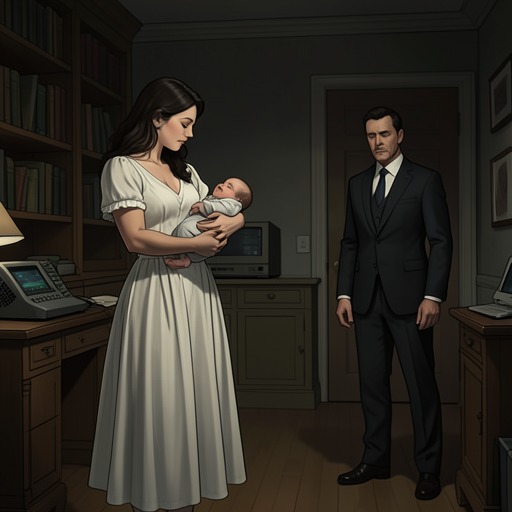
His family position becomes explicit when he appears as Tom's father and carries his grandson into the room. Lisa and Tom have named the child Alex Tang: Alex honors Lisa's father, while Tang honors Tom's childhood friend who died young. The baby resembles Tom except for his blue eyes, inherited as a visible echo of Lisa's former eyes. Zon's presence at this domestic threshold contrasts sharply with his auction-house entrance. The warlord who once represented threat now carries a tiny grandchild, participating in the continuity of a family that crosses human and T'shav lines.
Technology, Biology, and Legacy
Zon's world is technologically advanced, and his authority is inseparable from tools that reshape the body. At the auction he uses a small cylinder that emits a red laser to cut Lisa's cuffs. Later, aboard his ship, Lisa encounters holographic tablets, wall-scanning goggles, molecule breakdown stations that reduce waste to atoms and reform it into needed objects, and medical equipment capable of constructing a three-dimensional holographic image of her uterus. Zon remains beside her while doctors determine that the embryo is developing rather than mistaking it for a parasite.
The pregnancy gives his relationship with Lisa a biological and political consequence. The scan makes the cross-species future visible before the embryo resembles a recognizable baby; its projected form looks like a mixture of a tadpole and a dinosaur. Zon is anxious enough to verify that Lisa is carrying a pregnancy rather than an infection, but he stays with her as the examination proceeds. Their child therefore becomes evidence that the boundaries between human and T'shav life are not fixed, even as those boundaries remain socially and physically dangerous.
The broader narrative extends this crossing through other species. In a separate account, Shay explains that Stlozyn ancestors were humans taken from Earth centuries earlier, with emphasized genes and additional DNA strands enabling bodily transformation. That explanation places Zon's story within a larger pattern of migration, genetic alteration, and species classification. Across these narratives, human identity is not presented as biologically isolated: it survives displacement, recombination, and technological intervention.
Change and Narrative Significance
Zon's arc moves from apparent predator to complicated protector without erasing the violence that made his protection possible. He remains a warlord, carries weapons, commands soldiers, and uses lethal force, but the plot repeatedly places those capacities against acts of care: removing Lisa from the auction, staying with her during the pregnancy scan, accepting the obligations of a mate, and becoming a grandfather within a human-T'shav family.
The epilogue gives his development a public outcome. Sara is not expelled from the United Species Corps because Colonel Flanard's testimony is considered compromised; instead, the United Species assigns her to serve as an ambassador between the United Species and Zon's fleet. The appointment turns the rescue crisis into an institutional relationship. Zon's fleet, once associated with warlord authority and the threat of violence, becomes part of a diplomatic bridge between the United Species and the humans whose survival Sara and Tom helped secure.
Zon's significance lies in that conversion of force into connection. He begins as the frightening red figure at the back of an auction crowd and ends within a network of mates, children, grandparents, rescued humans, and diplomatic alliances. The narrative does not make him harmless; it makes his power answerable to attachment. His legacy is therefore carried not only by warships and reputation, but also by Lisa, Tom, their son Alex Tang, and the expanding political possibility represented by contact between his fleet and the United Species.